IB Notes

Populations in transition
MIGRATION
- Migration: The movement of people involving a change of residence. It can be internal or external (international) and voluntary or forced. It is usually for an extended period (more than a year) and does not include temporary circulations such as commuting or tourism.
- Immigration: The action of coming to live permanently in a foreign country.
- Emigration: The action of leaving one's own country to settle permanently in another.
- Ner migration gain / loss: Net migration is the difference between immigration and emigration in an area during a specified time frame.
- Internal migration: The movement of people within a country.
- In-migration: The movement of people into a particular town or district.
- Out-migration: When people move away from a particular district or town.
- Circularity: Returning home after out-migration.
- Migration classified by time : Permanent, semi-permanent, seasonal, daily.
- Migration classified by reason: Forced, voluntary, economic, religious.
- Migration classified by journey: International, regional, rural-urban, intra-urban.
- Physical factors (push): Inaccessibility, natural disasters, harsh climate
- Physical factors (pull): Fertile soils, lack of natural hazards, scenic quality.
-Economic factors (push): Heavy taxes, unemployment, poverty, resource explotation.
-Economic factors (pull): Good wages, good welfare service
- Social factors (push): High rents, lack of housing, growth of family, berreavement, discrimination
- Social factors (pull): Higher education, relatives, marriage, planning decisions
- Political factors (push): Discrimination, propaganda
- Political factors (pull): Freedom of speech, political asylum, propaganda
- Factors needed to be considered when migrating: Family, job opportunities, income, tax, cost of living, housing, health, cost of moving, visa.
- Volume of migration is inversely proportional to the distance travelled.
- Number of migrants going to a place is proportional to the number of opportunities availbale at the location.
MIGRANT WORKERS
- Migration can be permanent or temporary, long or short distance, internal or international.
- Migration labor is vital for economic development for both MEDCs and LEDCs.
- Trends include: globalization of migration, acceleration of migration, differentiation of migration into different types, feminization of migration.
REFUGEES
- Refugee: A person fleeing their home in order to escape danger
- Asylum seekers: People who seek refugee status in another country.
- Economic migrant: A person seeking job opportunities.
- Internally displaced persons (IDPs): Those who have fled their homes but continue to live in their own countries.
- Many refugees lack civil liberaties in their home country which has led to political repression or persecution.
- Africa contains over half of the world's IDPs (12million).
Push factors:
- Intolerance of one part of society towards another.
- Environmental deterioration (may be due to overpopulation).
- State persecution.
- Natural disasters.
- War or civil war.
GENDER AND CHANGE
- Glass ceiling: An imaginary pay scale or promotion that women find hard to go pass because of a bias towards male employees.
- Positive discrimination: When certain groups are favoured for employment and promotion when two people have the same skills or qualifications. Positive discrimination is sometimes employed when groups have been unfairly discriminated against in the past e.g. black people in South Africa during the Apartheid.
- Workplace quotas: When employers are expected to have a representative mix of workers e.g. half men, half women, some disabled people, some able bodied people, etc.
- Stereotypes: A standardised and generalised image or perception of a certain group of people.
Gender Inequality
- Early marriage contributes to early pregnancy and social isolation in women, resulting in a high fertility rate, low education levels and the cycle of poverty.
- Women suffer risks from pregnancy and child birth despite having a longer life expectancy in most countries.
- Women who are undernourished give birth to undernourished children with a weak immune system.
- In countries where boys are more favourable, girls recieve less nutritious food, medical care and the right to study and work.
- Discrimination against women is built into the culture, government policies and legal frameworks. Family laws codify discrimination against women and girls, placing them in a subordinate position to men within the family. This position is replicated in the economy and society.
- In many cultures it is not only traditional for a women to adopt her husbands name, but it also customary for her to go and live with her husband's family and in many circumstances pay her husband's family a dowry. These traditions have meant that many families actually favour sons over daughters
- In many cultures females will have no choice in who they marry, they may have their husband chosen for them or even be forced to marry someone that they have never met.
- Females are often expected to be virgins and remain faithful to their husband, while husbands have no such restrictions placed on them. Females sometimes suffer from honour killings because they have been accused of infidelity with no actually evidence.
- In many societies female domestic violence is accepted and not treated seriously by the police.
- Men are allowed more job and education opportunities and are entitled to occupations with higher wages than women (positive discrimination).
- Men account for 74% of the science and engineering labor force.
- Men account for over 90% of electrical, geological, mechanical and naval engineers.
- Few African countries have legislation in place to assire women's access to land and property. Formal law, traditional legal systems and societal norms deny women the right to acquire and inherit property.
Changes in female roles
- Some of the world's fastest growing countries are in MENA. But due to a revolution in marriage and childbearing in recent decades, the TFR has more than halved from 7 to 3 children since the 1960s.
- A rise in the costs and standards of living has resulted in more women focusing on their education and careers and marrying later in their lives. This has led to the decline in birth rates across MENA / Arab countries.
- More women are joining trade unions as an increasing number of them are economically active. They are making up an increasin share of membership in these unions.
- The involvement of women in paid imployment has led to the politicization.
- Women account for 48.8% of total migration in the 21st century. There is a higher percentage of female migrants in more developed countries and in countries where migration has been open for a long period of time.
- 2/3 of the total migration are people moving from developing countries to developed countries. These people tend to concentrate at the bottom and top of the employment ladder.
- 70% of all Filipino labor migrants are women but on the other hand, 69% of Mexico's emigrants are men.
- Many women are migrating from the Philippines, Indonesia and Thailand to become domestic workers or "sweatshop" workers (due to globalization).
* Gender inequalities in culture & status
- In a research that looked at the health, education and economic status of women, Norway ranked first and Somalia at the bottom. This included % using modern contraception, life expectancy at birth, expected number of years at school, % if government seats held by women, and ratio of female to male earned income.
- Canada dropped 3 spots from the previous women's index despite having a higher life expectancy and representation in government following the previous election. Canada may be able to improve in women equality if women spend more years in education and if they have a longer maternity leave.
* Gender inequalities in education
- Thousands of young women living in a part of Pakistan have been prevented from going to school after an order from Taliban forces which have seized control of much of the area. The Taliban have also introduced a parallel legal system where makeshift Sharia courts order lashes and death sentence for those seen to be violating their brand of Islamic law. “Yesterday there was a bombing of a school in Mingora, the main city,” he added. “No one is giving any education. Girls preparing for their matriculation exams in March have had to abandon their education. Unless the government or the Taliban announce that the situation will be ok, no one will take the risk.”
- For almost three decades, the International Development Association (IDA) has helped increase access to, and the quality of educational services in Yemen. The main achievements are the expansion of the education system at all levels, which helped halve the illiteracy rate to 45 percent from 90 percent, increased the gross enrollment rate in primary education to 87 percent in 2008-09 from 68 percent in 1998-99 and to 78 percent in 2008-09 for girls from 49 percent in 1998-99.
* Gender inequalities in health
- India's capital, Delhi, recorded more female than male births during 2008, for the first time in many decades. Data shows for every 1,000 males, 1,004 girls were born that year. A "Say No To Sex Selective Abortions" campaign urged locals and doctors to refrain from scanning pregnant mothers to determine the sex of foetuses. At the last count in 2001 the figure for females stood at 933 per 1,000 males.
- China has 32 million more men aged under 20 than women. High sex ratio areas in central China is worsening as in the past, migrants tended to go back home to permanently settle. But now, women are finding partners in urban areas and not going back. Men are unable to do that. Urban women will not marry a migrant man; men can't marry up. The gap is greater in provinces that allow couples to have a second child if the first is a girl. Among second-born children, boys outnumbered girls by 143 to 100 (based on the 2005 census). The one child policy has led to greater sex-selective abortions (illegal, but practiced) and is exacerbating the problem of gender imbalance.
* Gender inequalities in employment
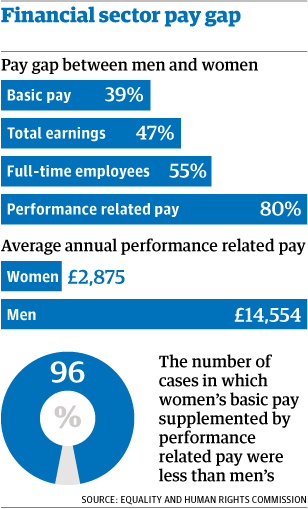
- UK: Women are jumping off the career ladder long before they hit the glass ceiling, raising serious questions about attempts to increase the number of female executives in company boardrooms. The Equal Opportunities Commission has found that 6,000 women are missing from top slots and reckons a lack of flexibility might be driving women towards setting up their own businesses. In recent years, there have been repeated attempts to encourage women to remain in work and to entice more of them into top level positions. But successive reports show that this does not appear to be happening.