IB Notes

Hazards and disasters
DEFINITIONS
- Hazard: A threat where natural or human that has the potential to cause loss of life, injury, propert damage, socio-economic disruption or environmental degradation.
- Hazard event: The occurent of a hazard, the effects of which change demographic, economic, and / or environmental conditions.
- Disaster: A major hazard event that causes widespread disruption to a community or region with significant demographic, economic and / or environmental losses, and which the affected community is unable to deal with adequately without outside help.
- Vunerability: The geographic conditions that increase the susceptibility of a community to a hazard or to the impacts of a hazard event.
- Risk: The probability of a hazard event causing harmful consequences including expected losses such as death, injuries, property damage, economy and environment.
WHAT ARE DISASTERS
- More than 10 people killed.
- More than 100 people affected.
- Declaration of a state of emergency by the relevant government.
- Request by the national government for international assistance.
Characteristics:
- Magnitude
- Frequency
- Duration
- Areal extent
- Spatial distribution
- Speed of onset / length of forewarning
- Regularity
- Impact
Geophysical:
- Hurricane (meteorological)
- Drought (meteorological)
- Tornado (meteorological)
- Lightning (meteorological)
- Earthquake (geological)
- Volcanic eruption (geological)
- Landslide (geological)
- Avalance (geomorphological)
- Flood (geomorphological)
Biological:
- Malaria (faunal)
- Wild fire
- HIV and AIDS
Human:
- Explosion at a chemical plant
- Leak of radioactive material
PLATE TECTONICS
DIVERGENT BOUNDARIES
- Where new crust is being generate as the plates pull away from each other.
- Magma rises from the mantle to create the new crust. The cooled magma forms a ridge.
- Results in shield volcanoes (from rising magma) and earthquakes.
An example of this is the Mid-Atlantic Ridge, a submerged mountain range. The North American Plate and the Eurasian plate is moving away from each other.
CONVERGENT BOUNDARIES
- Where crust is being destroyed as one plate dives under another.
- Crust is being created and destroyed at nearly the same rate.
Oceanic - continental (subduction zone)
- The denser oceanic plate will subduct under the lighter continental plate. This part creates the trench.
- Part of the subducted oceanic plate will melt due to increased friction and temperature.
- The newly molten rock is lighter than the rocks surrounding it. It will rise towards the surface and create volcanoes.
- The continental crust is crumpled by the two plates colliding, creating fold mountains.
- If the magma rises offshore it will form an Island Arc (West Indies and Japan).
- Causes violent earthquakes, volcanic eruptions, deep sea trenches, island arcs and fold mountains.
Oceanic - oceanic (subduction zone)
- One of the oceanic plates wills subduct under the other and from a deep sea trench.
- Forms underwater volcanoes.
- After years of piling up of volcano debris and lava, the submarine volcano rises up to become an island volcanoes.
- Such volcanoes are typically strung out in chains called island arcs.
Collision zone
- Where two continental crusts collide and is forced upwards.
- This movement and pressure can cause earthquakes, but no volcanoes.
CONSERVATIVE BOUNDARIES
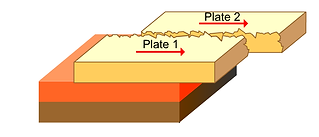
- Where plates slide horizontally past each other in opposing directions. Crust is neither produced, nor destroyed.
- The pressure keeps building until they finally jolt pass each other.
- The San Andrea's Fault is well known for this but the North American plate and Pacific plate are actually moving in the same direction but at different rates.
HOT SPOTS
- Hot spots occur where the Earth's crust is thinner and the mantle finds its way to the surface. They break through to form an island.
- The crustal plate is in constant motion. The island will eventually move away from the hot spot.
- More volcanic islands will form as the crust slide along.
PLATE BOUNDARY ZONES
- Where boundaries are not well defined and the effects of plate interaction are unclear.
EARTHQUAKES
- An earthquake is a sudden, violent shaking of the earth's surface. Powerful aftershocks may take place as well.
- Earthquakes are associated with all types of plate boundaries.
- The focus is the place beneath the ground where the earthquake takes place. Deep focus earthquakes usually occurs when there is subduction, while shallow focus earthquakes occur along constructive and conservative boundaries.
- The epicentre is the point on the ground directly above the focus.
- Earthquakes can be caused by humans: Nuclear testing, building large dams, drilling for oil, coal mining.
- Broad belts of earthquakes are associated with destructive and collision plate boundaries whilst narrowers belts are associated with constructive and conservative plate boundaries. Isolated earthquakes may be due to hotspots or human activity.
CHARACTERISTICs Of EARTHQUAKES
- Predictability: Historical events (trends in the timing of activity), laser measurement of crustal movements, animal behaviour, gas levels in ground water, minor earthquakes, changes in electrical conductivity, etc.
- Depth: Focus and epicentre. Depth is major factor determining surface damage. Deep focus = 300-700km, intermediate = 70-300km, shallow focus = 0-70km. Shallow focus cause greatest amount of damage and account for 75% of all quakes.
- Frequency: There are around 500,000 detectable earthquakes in the world each year. 100,000 of those can be felt. 100 of them cause damage.
- Magnitude: Richter Scale = degree of shaking. Mercali scale = amount of damage done.
- Duration: Seconds to minutes
- Speed of onset: Seconds
- Effects: Primary = Ground movement and shaking, damaged roads, collapsed bridges, and fallen buildings. Secondary = liquefaction, landslides, tsunamis, floods and fires.
FACTORS AFFECTING EARTHQUAKE DAMAGE
- Strength and depth of earthquake: The deeper the focus, the less damage caused as rocks absorb more of the energy.
- Number of aftershocks
- Population density
- Building type
- Time of day
- Distance from the epicentre
- Rock and sediment type: Loose materials may liquify. Buildings are more earthquake resistant if built on flat, solid rock.
- Secondary hazards: Contaminated water, disease, hunger, hypothermia, (see above).
- Economic development: MEDCs are more prepared, can respond faster, have better technology, health services and more funds and access to resources.
DEALING WITH EARTHQUAKES
- Improve forecasting and warning systems.
- Improve building design, building locations and emergency systems.
DROUGHT
- A drought it an extended period of dry weather leading to extremely dry conditions.
- Droughts usually occur in hot areas. They occur frequently in the southern areas as there are more heatwaves and deserts.
- Drought can be a combination of human and natural factors.
- About 38% of the world's land area has a level of drought exposure. It also has the greatest negative impact on human livelihood.
CAUSES:
- Dry descending air is associated with the subtropical high-pressure belt is the main cause of aridity around 20 - 30 degrees N.
- Distance from the sea, continentality, limits the amount of water carried across by winds.
- Cold offshore currents (in Atacama and Namib deserts) limit the amount of condensation into the overlying air.
- Intense rain-shadow effects as humid air passes over mountains (loses its moisture during percipitation on the top of the mountain. When air cools and warms on descending, it becomes very dry on the other side).
- Human activities: Deforestation which leads to soil erosion which leads to desertification.
CHARACTERISTICS OF DROUGHT
- Predictability: Easy.
- Frequency: Random.
- Spatial dispersion: In hot and dry areas.
- Speed of onset: Gradual.
- Duration: Months to years.
- Areal extent: Large