IB Notes

Membrane transport
* VESICLES MOVE MATERIALS WITHIN CELLS.
- A vesicle is a small, spherical sac of membrane with a droplet of fluid inside. Its fluidity allows it to change shape (constructed and deconstructed) and move around.
- Vesicles form when a small region of a membrane is pinched off. Proteins in the membrane carry out this process using energy from ATP.
- Vesicles can be seen in secretory cells.
- Protein is synthesized by ribosomes on the rER and accumulates in the rER. Vesicles bud off the rER and transport these proteins to the Glogi apparatus (and fuse with it).
- The Golgi processes the proteins into its final form. The vesicle buds off the Golgi and moves to the plasma membrane to be secreted.
- The plasma membrane needs to expand in a growing cell.
- Phospholipids are synthesized next to the rER and inserted into its membrane. Ribosomes on the rER synthesize membrane proteins and is inserted into the membrane as well.
- Vesicles transport the phospholipid and membrane proteins to the plasma membrane and fuse with it, increasing the area of it.
- This method can increase the size of organelles in the cytoplasm such as lysosomes and mitochondira.
* THE FLUIDITY OF MEMBRANES ALLOWS MATERIALS TO BE TAKEN INTO CELLS BY ENDOCYTOSIS OR RELEASED BY EXOCYTOSIS.
Endocytosis
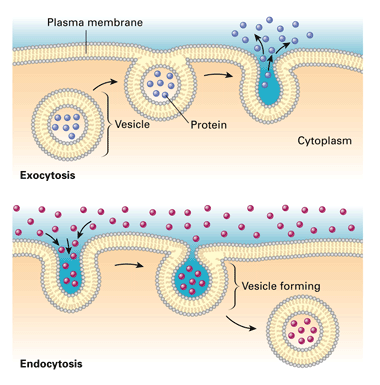
- The vesicle forms on the inside of the plasma membrane, encasing materials from outside the cell. They are taking inside the cell.
- Vesicles taken in by endocytosis contain water and solutes from outside the cell and also larger particles that can't diffuse through the plasma membrane such as antibodies from the mom to fetus.
- Unicellular organisms like Paramecium and Amoeba take in undigested food.
- Some white blood cells take in bacteria and viruses to kill them.
Exocytosis
- Vesicles containing substances from inside the cell fuses with the plasma membrane and releases its contents outside.
- The polypeptides in digestive enzymes are synthesized by the rER and processed by the Golgi. They are carried to the plasma membrane of gland cells to be secreted, (not excreted).
- Can be used to excrete waste products or unwanted materials.
- The contractile vacuole can excrete excess water in organisms like Paramecium by moving to plasma membrane.
* PARTICLES MOVE ACROSS MEMBRANES BY SIMPLE DIFFUSION, FACILIATED DIFFUSION, OSMOSIS AND ACTIVE TRANSPORT.
Simple diffusion
- Does not need energy (passive transport) because the net movement of particles go naturally from a high to low area of concentration.
- Involves partivles passing between phospholipds in the membrane (the bilayer is permeable).
- Nonpolar particles like oxygen can diffuse through the bilayer easily.
- Polar particles (with low charges) diffuse through the plasma membrane at slower rates. The centre of membranes is hydrophobic.
- Small polar particles pass through more easily than large particles.
Osmosis
- The net movement of water particles from a region of high to low concentration, through a partially permeable membrane.
- Solutes form intermolecular bonds with water molecules and restrict movement of it (low water potential). Areas of higher water potential are more free to move, resulting in the net movement of particles from a high to low water concentration.
- No enerygy is expended directly so this movement is passive.
- Osmosis can happen in all cells because water is small enough to pass through the phospholipid bilayer.
- Water channels called aquaporins greatly increase membrane permeability to water. Can be seen in kidney cells and root hair cells that need to absorb water.
- The narrowest point in aquaporins are positively charged and prevents the hydrogen atoms from passing through.
Facilitated diffusion
- Ions and other particles that can't diffuse through may use channels to do so.
- Channels are made of proteins and have a small diameter. Each channel have different chemical properties to allow only one type of substance to pass through.
- Helps particles move from a high to low concentration.
- Cells can control which type of channel to synthesize to control what substances can diffuse in and out.
- A carrier protein is different because they conform in order to let the molecule pass through. They are also specific to one substance.
Active transport
- Energy is needed to move or pump particles from an area of lower to higher concentration.
- ATP energy is made through cellular respiration and is used in active transport.
- Carried out by pump proteins (globular shape). There are many in the plasma membrane to strictly control the contents of the cytoplasm.
- Molecules enter the pump protein and reach the central chamber. Conformational change takes place (using ATP energy) and the molecule can pass through to the other side. The pump protein returns to its original conformation to repeat the process.
* STRUCTURE AND FUNCTION OF SODIUM-POTASSIUM PUMPS FOR ACTIVE TRANSPORT IN AXONS.
- A nerve impulse involves rapid movements of sodium, then potassium ions across the axon membrane.
- This is done by facilitated diffusion using sodium channels and potassium channels.
- The concentration gradient is built up (in order to allow diffusion to work) by active transport, using sodium-potassium pump proteins.
- The sodium-potassium pumps repeat a cycle of pumping out 3 sodium ions from the axon and then pumping in 2 potassium ions.
- Each cycle uses one ATP.
- Binding of an ion to the pump allows ATP to transfer into a phosphate group which conforms the pump. (See diagram above).
* FACILITATED DIFFUSION OF POTASSIUM IONS IN AXONS.
- Each potassium channels has 4 protein subunits with a narrow pore (0.3nm+) to allow potassium ions to pass in either directions.
- Potassium ions are less than 3nm but they are bonded to water molecules (surrounded by a shell of water) which makes them too big to pass through.
- Bonds between water and potassium are broken and replaced temporarily with amino acids in the narrowest part of the pore.
- After the potassium ion passes through, it bonds with a shell of water molecules again.
- Other substances can't pass through because they are too big to fit through the channel or too small to bond with amino acids.
- Potassium channels in axons are voltage gated. If an axon has more positive charges on the outside than inside, the channels will be closed with a globular protein (within milliseconds of opening) and vice versa. Cycle is repeated.
* ESTIMATION OF OSMOLARITY IN TISSUES BY BATHING SAMPLES IN HYPOTONIC AND HYPERTONIC SOLUTIONS.
- Osmosis is due ti solutes that form bonds with water. They are osmotically active.
- Osmolarity of a solution is the total concentration of osmotically active solutes, measured in osmoles or milliosmoles.
- Isotonic solution has the same osmolarity as a tissue. Hypertonic solution has a higher solute concentration and hypotonic solution has a lower one.
- Saline solution is the standard isotonic solution. It can also be used to rinse wounds, keep damaged skin moist prior to skin grafts, rinse eyes.
- Samples of a tissue can be bathed in hypertonic and hypotonic solutions to deduce the isotonic concentration. (Seeing whether water enter of leaves the tissue).
- Red blood cells will burst in a hypotonic solution and shrivel in a hypertonic solution.
* EXPERIMENTAL DESIGN: ACCURATE QUANTITATIVE MEASURMENTS IN OSMOSIS EXPERIMENTS ARE ESSENTIAL.
- There are doubts and uncertainties about most experiments and this can be minimized through rigorous experiments.
- The ideal experiments gives results with one reasonable interpretation and clear conclusions can be drawn. There should be strong evidence to support the hypothesis.
- Use the checklist below to see if an experiment is rigorous.
- Results should be quantitative, not descriptive to give stronger evidence.
- Measuremnts need to be exact, using precise apparatus and tools.
- Repetition of the experiment because biological samples may vary.
- Control variables must be kept the same.
* RIGOROUS EXPERIMENTAL DESIGN IS NEEDED TO PRODUCE RELIABLE RESULTS: HOW CAN ACCURATE QUANTITATIVE MEASUREMENTS BE OBTAINED IN OSMOSIS EXPERIMENTS?
- Osmolarity of a red onion cell can be measure as following.
- Peel off some epidermis from a red onion bulb.
- Cut off a 5 x 5 mm sample.
- Mount sample on slide with a drop of distilled water and place the cover slip on top.
- Through the microscope, the cytoplasm should fill up the space inside the cell, wall with the plasma membrane pushed up against it.
- Mount another sample of epidermis with 3% sodium chloride solution. If water leaves the cells by osmosis, the plasma membrane pull away from the cells wall because the volume of the cell is decreased.
- When membranes pulls away from the cell wall in plant cells, they are plasmocysed. The process is plasmolysis.
-The area of the cytoplasm can be easily seen so this is a good method to find out osmolarity.
* TISSUES OR ORGANS TO BE USED IN MEDICAL PROCEDURES MUST BE BATHED IN A SOLUTION WITH THE SAME OSMOLARITY AS THE CYTOPLASM TO PREVENT OSMOSIS.
- The area of a plasma membrane in a red blood cell doesn't change so when water leaves it, they develop indentations called crenellations. Conversely, if they swell up and burst, the ruptured plasma membranes are called red cell ghosts.
- Iotonic sollutions allow cells to remain healthy because there is no net migration of water molecules. A saline solution with 300 mOsm is used to bathe human tissues and organs during medicle procedures.
- Normal saline can be frozen to transport organs around.