IB Notes

Microeconomics
MARKETS
- Where buyers and sellers come together to carry out an economic transaction.
- Product market is where goods and services are sold.
- Labor market is where the FOP are bought and sold.
- Financial market is where international currencies are traded (foreign exchange) and where companies are bought and sold (stock markets).
DEMAND
- Demand is the ability and willingness for a consumer to purchase a good or service at a given price in a given time period.
- The demand curve shows effective demand where consumers can actually afford the G & S, not just want it.
The law of demand
- As price of a product falls, the quantity demanded of the product wull usually increase, ceteris paribus.
- A change in price will lead to a change in the quantity demanded or movement along the demand curve.
- When price of a product falls, people will have an increase in their real income. They will therefore be likely to buy more of the product.
- When the price of a product falls while other substitute remain the same, it becomes more attractive for consumers to buy.
The non-price determinants of demand
- These determinants will cause the demand curve to shift as the demand changes.
- There will be a higher or lower demand for something at every price when the curve shifts.
- Income:
- For a normal good, as income rises, the quantity demanded will too.
- For an inferior good, as income rises, the quantity demanded will decrease. When income gets to a certain level, consumers will only buy higher prices G & S. The demand for the inferior good will become 0 and the cuve will disappear.
- Price of other products:
- If a product becomes more favourable to consumers due to price changes, demand for the product's substitutes will fall at all prices.
- If a product's complement becomes more favourable to consumers due to price changes, demand for the product will increase at all prices.
- Changes in demand for one product will have no effect on another one if they are unrelated goods.
- Tastes:
- Marketing can persuade more consumers to use a particular product.
- Season:
- Weather may affect a consumer's desire for a product such as ski jackets and bikinis.
- State of the economy:
- During a recession, many people prefer to save their money due to financial instability. Demand will fall as a result.
- Population:
- If there are more people, there should be an increase in demand for many goods and vice versa.
- Age structure:
- People in different age groups have desires for different G & S.
- Income distribution:
- If there is a change in this factor and say for example, the poor are better off, the demand for basic necessity goods such as eggs will increase.
- Government policy changes:
- If there is a change in direct tax, disposable income will change and demand will be affected.
- If the government bans goods like drugs or make it compulsory to have seatbelts in every vehicle, demand in the relevant markets will change.
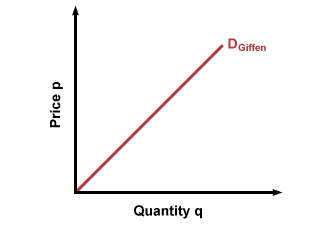
GIFFEN GOODS
- Basic necessity goods where when price decreases, demand decreases with it as well. This is because consumers feel like they can buy a better alternative.
VEBLEN GOODS
- High end products where when price rises, demand rises with it as well. This is due to conspicious consumption where people gain satifaction from being seen with expensive items by other people.
- These goods have a snob value and ostentation. Examples include: LV handbag, tailor made car, piano encrusted with crystals.
- When the price fall below a certain value (snob value status line), the demand curve will take its original form as the goods won't be deemed ostentatious anymore.
LINEAR DEMAND FUNCTIONS
- These functions help us show the relationship between the demand for a product and individual determinants of demand.
- Qd = a - bP
- a is the autonomous (independant) demand or demand for a product at $0. Changing the value will shift the curve.
- b is the gradient (showing price elasticity of demand) for a product. The lower its value, the steeper the gradient and the less elastic it becomes.
- P is the price, showing the decrease in demand (when multiplied with b) for every increased unit of price.
SUPPLY
- Supply is the quantity of a product that a producer is willing and able to sell to a market at a given price in a given time period.
- Supply can sometimes be fixed.
- The supply curve usually gets steeper if price increases too much.
The law of supply
- As price increases, firms are likely to expand production. There will be movement (expansion or contraction) along the supply curve.
- There are greater profit margins per unit if the selling price is high.
- New firms are attracted if they are able to cover their costs of production due to the higher price. The opportunity cost will be covered.
- A change in market price will lead to movement along the supply curve.
- If substitutes of a product become more profitable to make, suppliers may produce it instead. This will cause a contraction (movement) along the supply curve.
The non-price determinants of supply
- If non-price factors changes the supply, it will lead to a shift in the supply curve.
- Size of market (age group / population): There will be a larger supply with more people in an area. Supply will respond to demand.
- Level of technology: A highly industrialized country with advanced technological machines and equipment will run more efficiently.
- Government regulations / policies: The government can limit supply of a product or the way a product is made.
- Expectations related to demand or price of products:
- Supply will change to satisfy the demand.
- Producers will produce and sell what they predict to be most profitable.
- If demand is predicted to fall in the future, suppliers will decrease their units of production to avoid wasting time, money and resources.
- Subsidies and indirect taxes: This affects the cost of production and profit margins.
- Price of FOP (costs of production): A higher cost of production may not be very profitable.
- Weather: It can impact the supply of raw materials used to make the good or service.
- Man-made or natural disasters: Can destroy raw materials and slow production process.
- Transport and infrastructure: Convenience and efficiency increases the supply.
- Barriers to entry: If there are high barriers, supply may be restricted.
LINEAR SUPPLY FINCTIONS
- Qs = c + dP
- c is the supply when the price is 0
- d is the slope of the supply curve.
- If the government can subsidize output, there can be supply at $0 (on the supply axis).
- These curves usually intercept at the Price axis.
- The shallower gradient has a bigger response.
- When commenting on supply curves, include axis intercepts, elasticity and the sector of production.
PRICE ELASTICITY OF DEMAND
- Elasticity is the degree of responsiveness of quantity demanded due to a change in another factor due to PED, YED or CED (related products).
- PED is the measure of how much the demand for a product chanfes for a given price change.
- Inelastic is a relatively small change in demand. (Between 0 and 1)
- Elastic is a relatively large change in demand. (Larger than 1. Equal to 1 is unitary)
- PED is the percentage change in Qd over the percentage change in price. Ignore the negative sign.
- If PED is -1.0 and the firm raises price by 4%, demand decreases by 4%.
- Factors affecting PED: substitutes, durability, time lag, percentage of income, addiction & habits (necessities & fashion).
- Over time, the PED for products will increase.
- The higher the price, the more price elastic a product becomes. In the middle of the PED curve, the price elasticity is 1; on the left end, the price elasticity is infinitive; on the right end, the price elasticity is 0. This is due to the % of income spent on the product.
Its importance:
- Pricing policy or strategy (airlines, hotels, amusement parks, restaurants).
- Economic impact on product (jobs).
- Exchange rate impact on product (Saudi Arabia's exchange rate and the oil they sell).
- Tax policy (taxes imposed on demerit goods).
- The light grey signifies the revenue gained and the dark grey signifies the revenue lost.
- The bigger box shows wether there is an increase or decrease in revenue.
Price inelastic products: medicine, salt, rice in China, oil, private education, tap water, electricity, wifi in 1:1 laptop schools.
Price elastic products: clothes, apples, public transport in Hong Kong, specticle frames, fast food, stationary,
INCOME ELASTICITY OF DEMAND
- The measure of how much the demand for a product changes for a given change in consumer income.
- It is the % change in quantity demanded divided by the percentage change in income.
- The value of YED can be positive (normal goods: luxury and necessity). As income rises, so does the quantity demanded.
- Necessities (electricity) have a YED between 0 and 1. Luxuries (rolex watches) have a YED of over 1.
- The value of YED can be negative (inferior goods like public transport). As income rises, the quantity demanded falls. Quantity demanded should rise during an economic recession.
- YED is useful because classification could be different depending on the target market.